
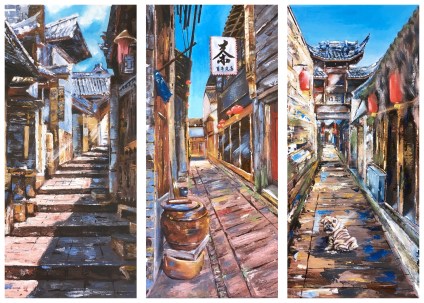
This set is inspired by Luxun’s Hometown 魯迅小說《故鄉》, a modern classic literature. I also like to portray the deserted town as a consequence of industrialization.
時候既然是深冬;漸近故鄉時,天氣又陰晦了,冷風吹進船艙中,嗚嗚的響,從蓬隙向外一望,蒼黃的天底下,遠近橫著幾個蕭索的荒村,沒有一些活氣。我的心禁不住悲涼起來了。
It was deep into winter at that time. As I drew near my hometown the day became overcast. Cold wind blew into the boat cabin making a swooshing sound. Looking out through a gap I saw underneath the sombre sky were several desolate uninhabited villages scattered far and near, void of any sign of life. Overpoweringly my heart sank at these sights.
1. Best Inn in Town 古樓客棧
The inn on the painting bore the names of my childhood friends Wing and Paul 穎輝. If you look closely you will find two birds as guardian angels resting on the roof opposite the inn – symbol of harmony and unison 長長久久. That’s the artist secret that I unveiled after this painting was acquired by a Canadian patron.
2. Qing cha dan fan 清茶淡飯
The second episode literally means light tea and plain rice, implying a humble lifestyle. This is inspired by my favourite Chinese song, Afternoon Tea 下午茶, about friendship against the odds.
就讓重要的人去趕場
那就讓聰明的人去堅強
我們享受一杯下午茶
Let the important people join the race
Let the smart people persevere
We’d rather enjoy a cup of afternoon tea by ourselves
3. Brief Encounter at Eastgate 東門偶遇
The last episode is inspired by a Cantonese love song 偶遇:
心 印下微笑的影 天天去回味
迷人是一剎那 再回頭已是沒法追
會是如歌 會是如詩 怕沒法遇
My heart – imprinted with the shadow of your smile
Mesmerising day after day
That fleeting moment is the most enchanting
It was too late when I turned around
Just like a song, or a poem
It daunts me that we may not meet again

I deliberately left out people as I wanted to accentuate the desolate mood of a remote town. But I couldn’t bear the depressing aura so I decided to brighten it up with few vibrant strokes.
That still did not convey the story about reminiscence of a magnetic smile at first sight. As an afterthought, I added a Shar-Pei 沙皮狗 stopping half way, looking back at us, full of wonder with a hint of sparkle in his eyes.
Reincarnation prevails in Chinese philosophy and that lost soul has returned in a different form to make up the lost times.
As with many of the Chinese breeds, Shar-Pei 沙皮狗 has an ancient legacy. In fact drawings on antique pottery found by archaeologist suggest Shar-Pei have been around since before 200 BC. They are physically similar to Chow Chow 鬆獅狗 which clearly share the same ancestor.
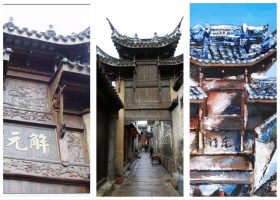
One other interesting alteration, I have deliberately renamed the gate to East Gate 東門 to evoke romanticism, like the Dream of Red Chamber 紅樓夢.
The original gate has the banner of “jiè yuán” 解元, located in an old village in Suzhou 陸巷古村. Though I have full respect of keeping the legacy I think this is a bit dull in fitting into my story.
Jiè yuán 解元 means a first-placed candidate in the provincial imperial examination 科舉 in the old days. That sounds impressive but there are two more levels after that. To come first in the civil examination in the national capital is Huì yuán 會元. To come first in the palace examination is Zhuàng yuán 壯元 which is fondly used today to describe someone attaining all As at A-Level or GCSE equivalent. Obtaining the three highest literary degrees in succession is called 連中三元. That is crème de la crème!
 David Ko 高永偉