
1. Farewell my Concubine 霸王別姬
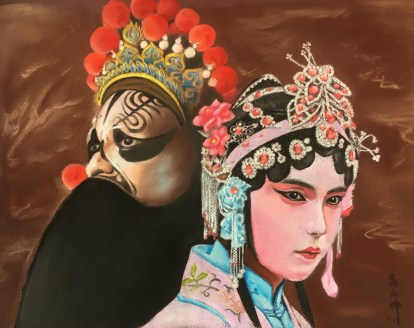
This set explores the cross-gender role in Peking opera, nandan 男旦 where a male actor plays the leading female role. Chinese opera has a long history dating to feudal China of more than 1,000 years ago.
Unlike its counterpart in Western theatre and pantomimes, the nandan was never a humorous or an ironic act of a man trying to sing and act like a woman. The nandan must transform themselves totally and it takes years of apprenticeship from childhood to perfect the feminine gestures and mannerisms on stage. People quite often overlook the intricacies behind the scene, the art of cai qiao (踩跷) performing tip toe throughout the whole show, self make-up transformation from man to woman, elaborate headgear, and delicate water sleeves dance. Today there are only few nanda choosing this career.
My first episode is Farewell my Concubine 霸王別姬, a beautiful and harrowing classical story about political unrest, love, sacrifice and honour. It would be hard not to be entranced by this immense love story and the traumatic consequences of lost battles and pride.
2. Transformation 搽脂抹粉
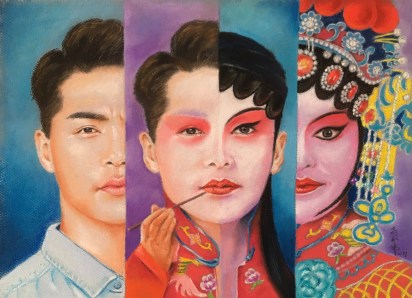
This is the second episode of my Peking Opera series. Here I want to zoom in to show the aesthetic transformation of a nandan 男旦, using soft pastel to mimic real makeup.
3. Life is Art, Art is Life 假戲真做

Does art imitate life, or life imitate art? In this finale, I delved into further by exploring the psychological complex of a perfectionist nandan 男旦 assuming femme fatale role 禍水紅顏. To perfect the act, the artist trespasses by bringing the stage to real life. He becomes his alter ego female role and lives in a deluded world that runs parallel with the stage scenes. With a twist of fate, a singular unfulfilling world tragically results in rejection and self destruction.
Behind the Facade
- White foundation: a white fixing powder was dusted down to cover all the face up to lips, in very generous quantities! Rouge accents are applied on the cheeks and swept upwards
- Hair: a black bandage is tightly bound around the head. Fake hair is then applied.
- Jaw/chin: typically man has wider jaw. To give a feminine appearance, strands of hairs are applied on the side of face. This gives more definition by accentuating the oval shape 鵝蛋面 and pointed chin, the idealized Chinese concept of feminine beauty.
- Nose: to enhance the sculpture, white powder is applied in the middle to give the impression of a straight nose.
- Eyes: eyes are circled in rogue. Eyelids are lined and darkened to make them look bigger, with a pointed tail end to exaggerate oriental beauty in the shape of almonds. In order to make the ends of eyes tilt upwards, hair was pulled back and fixed in place with adhesive tape! This is the epitome of female beauty in Chinese convention.
- Eyebrows: eyebrows were covered with white powder and the eyebrow lines were reinvented with paint. Of course the signature upward slanting line up to the hairline accentuates that quizzical look.
- Lips: Unlike the pouty rose bud lips of Japanese geisha, Chinese lips are shaped like a little flower. To make it, first made an obvious depression in the middle of the upper lip. Then the upper lip contour took the shape of two petals, and the lower lip another petal. Traditionally, woman hold a sheet of rouge paper 胭脂紙 within lips to color their lips.
 David Ko 高永偉